
|
"Hardly any wetland bird is more easily identified than the Roseate Spoonbill"
This article contains information relating to a former cryptid. Former cryptids are either cryptids proven to exist, or those that are no longer considered cryptids. |
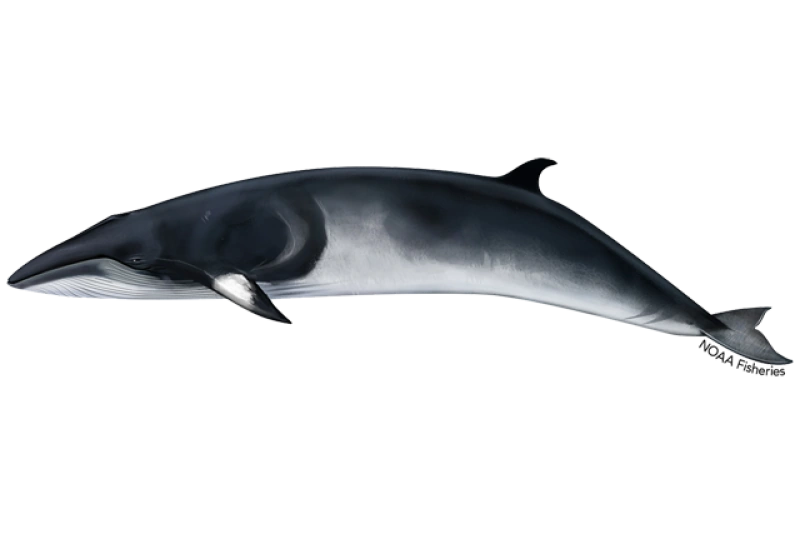

An Antarctic Mink Whale
The Bio-Duck is a sound recorded in the Southern Ocean, particularly in Antarctic waters and off the West Coast of Australia. First reported by submarine personnel in 1960, the sound was given its name due to its resemblance to a duck's quack. For decades, its origin remained one of the largest unresolved mysteries of the Southern Ocean, until 2014, when it was identified as being produced by Antarctic minke whales.
The sound falls within a frequency range of 60 Hz to 100 Hz, with harmonics extending up to 1 kHz, and has intervals between 1.6 to 3.1 seconds. It is typically heard during the austral winter, primarily in the Southern Ocean, and is detected near the surface before the whales make feeding dives. Though the exact purpose of the sound is still unclear, it is believed to possibly play a role in mating.
This discovery is important for studying the seasonal presence, migration patterns, and population of Antarctic minke whales. Acoustic research is more cost-effective than visual surveys, as it can be conducted regardless of weather or daylight conditions. Furthermore, acoustic methods are particularly valuable in areas with heavy sea ice, where traditional ship-based research would be difficult.
Discovery
In the austral summer of 2013, a research team led by Denise Risch attached suction-cupped recording devices to two Antarctic minke whales to study their behavior and vocalizations. The devices were deployed using a pole from a boat, and they recorded a variety of data, including sound, temperature, pressure, acceleration, and magnetic fields. During the 18-hour and 8-hour recording sessions, the two tagged whales were observed to feed continuously.
Throughout the data collection, the researchers recorded 32 vocalizations, 6 of which resembled previously known bio-duck sounds, a distinct vocalization often linked to Antarctic minke whales. Additionally, they recorded low-frequency down-sweeps, a sound commonly associated with these whales. Given that no other marine mammals were observed within 1 km of the tagged whales and that the whales were traveling in single-species groups of 5 to 40 individuals, the research team concluded that the sounds originated either from the tagged whales or from other Antarctic minke whales within the group.
This study helped provide more insight into the vocal behavior of Antarctic minke whales, particularly their use of unique sounds for communication or other purposes, such as navigation or social interactions, within their pods.
Investigation
Research conducted off the West Coast of South Africa investigated the factors influencing the frequency of bio-duck sounds produced by Antarctic minke whales. The study analyzed three key variables: the "distance from the sea ice edge," the "month of the year," and the "time of day." The researchers found that the month of the year was the most significant factor affecting the occurrence of bio-duck sounds. This was followed by the distance from the sea ice edge, with time of day being the least influential variable.
Further research corroborated these findings, showing a positive correlation between the presence of sea ice and the time Antarctic minke whales spent calling. In particular, the study indicated a noticeable increase in calling behavior once the sea ice coverage reached approximately 50%. Researchers hypothesize that this threshold may be important for triggering significant calling activity, suggesting that sea ice presence plays a key role in the whales' vocal behavior, potentially linked to feeding or communication patterns.
Function of Sound
The function of the calling behavior of Antarctic minke whales remains uncertain. While early hypotheses suggested that the bio-duck sounds might serve as a means for navigating areas with dense sea ice, more recent acoustic studies have cast doubt on this idea. Research has shown that these bio-duck sounds are not exclusive to regions with sea ice. For instance, bio-duck sounds have also been detected at lower latitudes, such as off the coast of Namibia and the Perth Canyon, areas with no sea ice. This suggests that the calls may serve a different function, potentially related to communication, social interactions, or other environmental factors, rather than navigation in sea-ice-covered waters.