The Moas (Dinorniformes) were giant flightless birds native to New Zealand. They were comprised of 9 species in 6 genera, ranging from the size of turkeys to surpassing the ostrich in size. The largest was the South Island Giant Moa, which could grow to a height of about 3.6 meters (about 11ft) and weigh up to 250 kg (about 770lb).
They belonged to a group of birds called ratites, which also includes ostriches, emus and kiwis. Genetic studies suggest that the closest living relatives of the Moa are the flighted tinamous of South America, once considered to be a sister taxa to ratites.
They were the largest land animals in New Zealand, being found in forests, shrubland and subalpine habitats. The Moa's main predator was the Haast's Eagle, the biggest eagle to have ever existed. Both became extinct soon after humans arrived 700 years ago. Their main cause of extinction was overhunting by the Maori, who exploited their abundance, along with the mammalian predators they brought with them, causing them to go extinct within a hundred years of their arrival. The Moa was forgotten until the Europeans' arrival when its remains were found.
History and Extinction
It is believed that early ancestors of these birds could fly, reaching New Zealand around 60 million years ago. They soon became flightless due to the lack of predators, losing their wings completely. For millions of years they lived in isolation, with only the Haast's Eagle being their main predator. Moas are believed to have become extinct soon after humans arrived. Overhunting, habitat destruction and the introduction of mammalian predators by the Maori were the most likely reasons for their demise.
Sightings
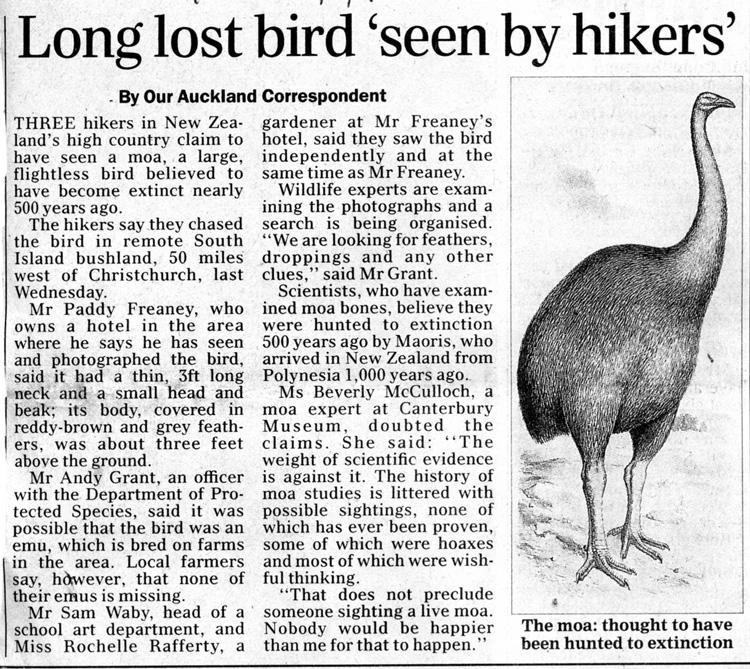

A news article about the 1993 Moa sighting.
Modern science tells us the Moa went extinct more than 500 years ago, soon after the settlement of New Zealand, however sightings of the Moa have been numerous throughout the years, occurring most commonly in the remote parts of New Zealand. It has been speculated that the smallest species of Moa could have survived in the remote and dense forests of Fiordland and the west coast until fairly recently, as these areas were virtually undisturbed until the Europeans' arrival. Most sightings of the Moa occurred in the colonial era when surveyors and prospectors started exploring the remote New Zealand wilderness.
- In the 1820s George Pauley claimed to have seen a bird "20 foot high" by an unnamed lake in the Otago region of southern South Island. Pauley ran away from the bird.
- Walter Buller wrote that the Maoris claimed a large kiwi lived in the Chatham Islands until about 1835.
- In the 1840s, Australian bird painter John Gould reported seeing what he described as "giant kiwis" on the South Island of New Zealand, that were around a meter tall and had spurred feet. Gould's description of spurred feet matched fossilized Moa footprints found on the North Island.
- In 1842 William Colenso was told by a 'mechanic' who had recently come from Cloudy Bay that the moa existed in the Kaikoura ranges. One night two Americans and a Maori guide took weapons, he said, and 'ascended the mountain to the place where these birds resort, where, at the native's request, they hid themselves behind some bushes. Presently they saw the monster majestically stalking down in search of food; they were, however, so petrified with horror at the sight as to be utterly unable to fire... they observed him for near an hour... They described this animal as being fourteen or sixteen feet in height' (Colenso 1879, p. 69).
- In about 1844, the crew of the whaler Magnolia reported trapping a "big emu" weighing about 227kg. The captain who was a taxidermist was said to have preserved the bird to send it to the "London Museum," however no known specimen was ever sent to the museum.
- In April 1850 a seal hunter found Moa bones with flesh still attached at Molyneux Harbour, on the South Island.
- An expedition in the 1850s under Lieutenant A. Impey reported two emu-like birds on a hillside in the South Island (Fuller, Errol, 1987).
- One evening in 1858, in the goldfields district about Mount Arthur, a moa 14 ft tall was chased into a cave by miners. The next morning the miners returned and found a young bird like a goose, covered in yellow down, which they exhibited to others at a shilling a head (Otago Witness, 2 October 1858).
- In 1859 'Four English migrants... farm labourers... proceeded to Golden Gully [Takaka Hill range] looking for work, and shortly after went some miles further on prospecting, I presume. They returned in great alarm one day stating that they had come suddenly upon an enormous bird standing at the entrance to a cave or hollow on the hillside. They described the bird as standing about 8 ft. or 9 ft, of a brown colour, with a red mark around the eye. With the greatest difficulty we persuaded them to show us the spot... and we examined the cave and other places for the period of two or three days... these countrymen were thoroughly frightened... [and]... had never heard of a moa... I do not think they could ever have been twenty miles from their home.' (Major Locket to H.C. Field, in Field 1893, p. 564).
- In 1860 a shepherd called James Cameron, who had just arrived from Scotland, took up a job on the Manapouri Run. One day he came to the eastern bank of the Waiau River and 'To his great surprise he saw a huge bird emerge from the scrub on the opposite side of the river, walk along the sandy river bank, and finally disappear. At the time he had not heard of the Moa.' (Beattie 1958, p. 38).
- In January 1861, fresh-looking, three-toed prints about 34cm (14 in) long were found in the mountains between Takaka and Riwaka in northern South Island by members of a surveying party (Fuller, Errol, 1987).
- A sighting appeared on the Otago Daily Times newspaper about a sighting of a Moa near lake Wakatipu in the 21 January 1863 edition “It appears that two miners, James Walker, and Joseph Smith were about a fortnight ago camped about 20 miles to the north of the workings at the Arrow River. In the evening they observed on the spur of the hill above them, a large bird apparently seven or eight feet high. It was distant from them some three or four hundred yards. The bird sat down for about ten minutes, and while in that position was carefully observed by James Walker, who states that it was as tall as himself, and had a long head as large apparently as that of a horse. The bird then walked away. On the following morning the men examined the tracks, when they found the foot marks of a bird with three large toes each a foot long, and spread out a foot wide, a short toe five inches in length projecting behind.”
- In 1863 a recently arrived immigrant named Cottier was walking beside a creek that flowed into the Mokihinui River on the West Coast. It was early morning and he suddenly noticed a bird like a giant woodhen most commonly known as a weka (Gallirallus australis) about 200 m. away. Its head was hard looking, dark coloured, and flat at the top, with a semi-circle of red below the eyes. The head of the bird was as large as that of a calf, and standing about eight feet from the ground.' Cottier observed the bird for some time and then returned to his camp for a gun. When he came back the bird was gone (Nelson Examiner, 12 May 1863).
- A sighting was reported on by the Otago Daily Times newspaper on the 23rd of July 1863 “And lastly, they saw a bird, or something like what the “Moa” is said to be. This bird they consider stands about 9 feet high, it made its appearance at the camp one night and thrust its head over the fire but only remained a very short time; the dogs gave chase, and they heard it for some time making its way through the timber. The impression left by its foot was about eight inches in length and about four in width, and pointed in the form of a toe at each end, and from appearances the leg bone must be situated about the centre of the foot” (the next parts are unreadable so the story ends here).
- In 1867, 4 gold miners claimed to have seen a Moa. “On Saturday, July 27, about four o’clock in the afternoon, whilst enjoying a pipe by the side of a small fire in our hut, with the door open, my attention was suddenly directed to a large animal on the opposite range, I was not long in doubt as to what the stranger was. My mates cried out, "It’s the moa" and the moa sure it was. The bird must have been more than a mile in a straight line from us; but as the horizon was clear every movement could be detected. The bird was evidently going at a great pace, and I can only compare it to the movements of the emu or ostrich. We had a full view of the bird for more than two minutes, when he suddenly disappeared on the other side of the range.”
- In 1868, Sir George Grey received a circumstantial account of a recent killing of a small Moa which had been captured from a drove of six or seven birds by a party of Maoris at Preservation Inlet in Fiordland.
- In 1870 a group of twelve to fourteen prospectors about 100km. up the Rangitikei River saw a moa. It was during a cold winter with heavy snow on the ground and the sighting 'frightened the life out of the lot of them. They cleared for their bare lives... [when the moa came out of the bush and stalked across a clearing]'. Later a sheepfanner called Sutherland said that he saw the moa. 'It must have stood 16 ft. or 17 ft. high, and the body a tremendous size... it was speckle or greyish colour, with a woolly look.' (Olsen to H.C. Field, in Field 1893, p. 565).
- In 1873 a shepherd's dog flushed a moa from a patch of scrub near the Waiau River. `The moa ran from the dog until it reached the brow of a terrace above him, and some thirty or forty yards off, when it turned on the dog... The moa stood for fully ten minutes... bending its long neck up and down exactly as the black swan does when disturbed. It is described as being very much higher than any emu... and as standing very much more erect on its legs. The colour of its feathers is described as a sort of silvery grey, with greenish streaks through it.' (Otago Witness, 5 April 1873).
- In November 1876, according to the Rangitikei Advocate, Mr George Slight, working on the Parackaretu block, saw a young bird about four and a half ft. high, with a long hooked bill and very small wings. He and a Mr Hunt gave chase, but the bird ran away from them very swiftly.' Next morning their employer measured the bird's footprints and found that they were larger than his own and showed evidence of partial webbing. The weather at the time was intensely hot according to Haast (1948, p. 804), who records this odd tale.
- In 1878, several people reported seeing a silver-gray bird larger than an emu on a station near Waiau, South Island. In one instance, a sheepherder's dog flushed the bird from a patch of scrub and chased it for about 40 yards before it turned and chased the dog. The moa stood for ten minutes watching them, bending its long neck up and down like a swan.
- In 1880, 8 year old Alice Mackenzie, while living at Martins bay in the southwest coast of the South Island, had an encounter with a large bird she believed for many years to have been a takahe. But when the takahe was dramatically rediscovered in November of 1948, and Alice saw what it looked like, she realised she'd seen something else. In 1959, she was interviewed by the New Zealand Broadcasting Service:
"It was lying on the sand, sunning itself.
"I got nearer and nearer until I sat down on the sand behind it. I remember stroking its back. It had no tail.
"It just lay there, it was quite quiet. So I put my hand underneath it and drew out one of its legs. It took no notice of me. I started to tie the flax around it, I thought I'd tie it up.
"Then it got up and made a harsh, grunting cry and bit at me. And I ran as hard as I could over the sandhills towards the sea. I thought if I went down to the sea it mightn't follow me into the water. I never looked behind, it never came very far with me.
"When I got home and told my father he came to have a look. But the bird was gone when he came. He saw its tracks where it had followed me from the top of the sandhills but it didn't go over them.
"He had a foot-rule in his pocket and he measured [the tracks]. From the heel to the middle toe was 11 inches."
She described the bird as “A fairly tall bird with bright blue plumage;" Alice would go on to see the bird multiple times, her father and her brother also saw the bird many times.
- In 1896, some schoolboys saw a Moa-like bird cross a road in the Brunner Range, South Island.
- In about 1928, Jules Berg and Arawata Bill were heading to Milford from Preservation Inlet; one night near Lake Widgeon they set up camp at the head of the inlet, in the early morning Jules suddenly awoke and heard what sounded like deer drinking from a nearby stream, it seemed like a good opportunity to shoot some deer so he took his rifle and torch and set off. When he was ready to shoot he turned on his torch, which revealed 3 objects like giant fowls standing about a meter tall, for a moment he was stupefied and in that instant the birds fled. Returning later in the morning with Arawata Bill they found footprints on the bank, they then measured the height of the rock background and estimated the birds were around 4 feet tall.
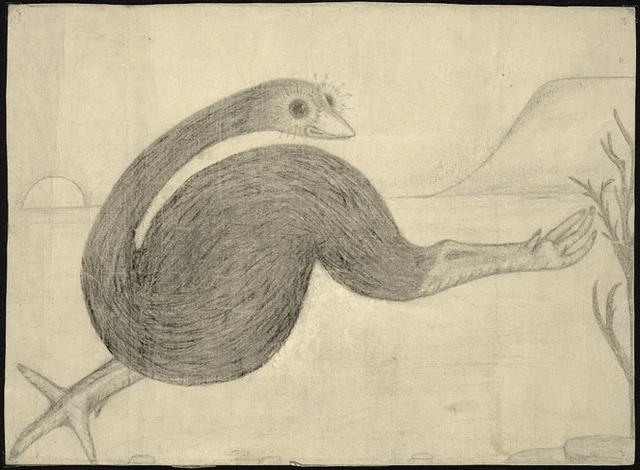

A drawing of the Moa seen by miss Chell in 1940.
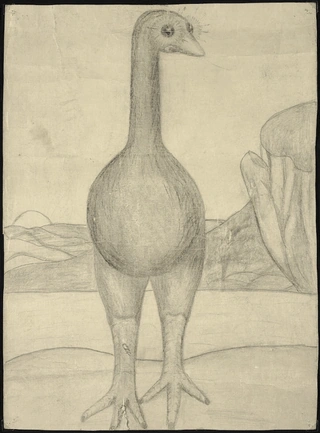

A drawing of the Moa seen by Miss Chell in 1940.
- In 1940, a woman by the name of Miss Chell saw a Moa along the Buller river from her car. ‘(ODT, 18 September 1958).
- In 1963, a scientist saw a large, Moa-like bird in the brush at Boulder Lake in the North-West Nelson State Forest Park, South Island (Spittle, Bruce, 2010).
- In 1976, a pair of Moa were observed by a group of trampers on the heaphy track in the South Island. (Spittle, Bruce, 2010)
- In May 1991, hiker Jim Straton saw an enormous, dark-colored bird cross a hiking trail in front of him along the Waimakariri River. He estimated its height at 11 feet.
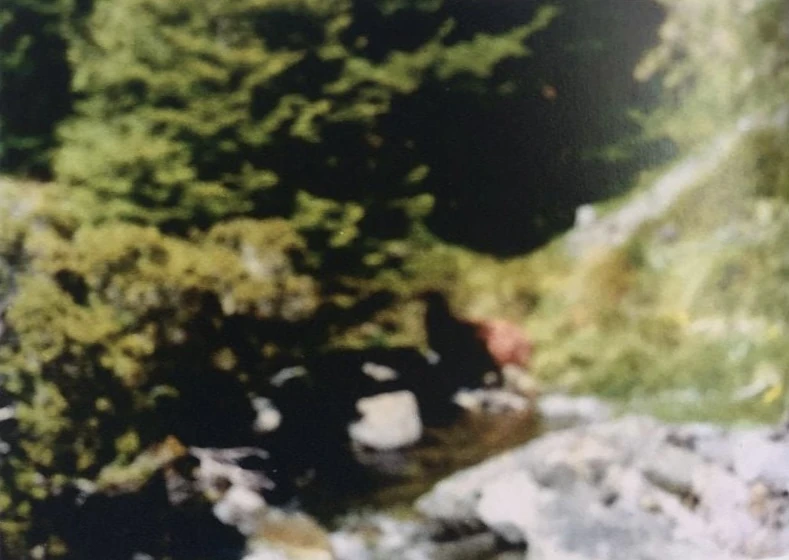

Picture of a fleeing moa taken by Paddy Freaney.
- In 1993, three hikers claimed to have seen a Moa in the Craigieburn Range in Arthur's Pass. One of them, former SAS soldier and mountaineer Paddy Freaney, had managed to chase the bird and take a photograph of what appeared to be a fleeing Moa. Later analysis by specialists at the Canterbury University concluded that the picture seemed to show a genuine bird. A year later in the same vicinity, a physician found unusual browsing damage on plants that could only have been made by a Moa.
- In an interview in the days following the 1993 Moa sighting it was reported that around 5 years ago a group of possum hunters encountered a Moa up in the Taipo valley. One of the hunters who was walking up a ridge noticed he was being followed by a deer like animal with 2 legs. After setting his bait he continued up to the top where he was picked up by a helicopter. It was decided that they would fly around to try and see what was following him. They then saw what looked like a giant weka (a weka is a flightless bird belonging to the rail family that is endemic to New Zealand). A couple of months later 2 members of the party went to the same area again to try and find what they saw. While down in the lower part of the valley they heard an unknown screeching sound of an animal coming from multiple directions. Continuing further up the valley they then encountered a giant weka-like bird that poked its head out of the bush and having not noticed the 2 men, started squawking.
- In the same interview, another sighting was reported by a local helicopter pilot and his mate. They described encountering and netting a Moa from their helicopter while they were out netting deer for capture around 3 weeks before the interview. Soon after trying to tie it up the mate was kicked by the Moa and sent tumbling down the hill. It was described as looking like a huge weka. This account occurred in the Craigieburn area. (The Moa Mania of 1993, 25′05″ Spectrum).
- In a stuff news article dated January 31, 2009, Rex Gilroy describes a 2nd hand account of a sighting by “some road workers, in the pouring rain, about 10 years ago, in the Eglinton Valley before the Milford Tunnel. They were in a shed, waiting for the rain to stop, and on the edge of the jungle were two birds emerging from the bush, about eight feet [2.4m] in height. And they were chewing leaves off trees.”
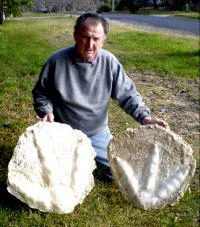

Rex Gilroy holding casts of a Moa footprint
- In March 2000, cryptozoologists Rex and Heather Gilroy supposedly discovered the footprints of a large bird in the Urewera National Park. “After 20 years of field researches, during our 2000 expedition on Friday 17th march our efforts were finally rewarded. We had begun a search in the Te Urewera National Park inland from Hawkes’ Bay on the eastern side of North Island. Finding an old disused track we followed this up a forest-covered mountainside. Below us, down a steep forest-covered slope was a gully. The track at this point was about 2m wide with a 1.5m bank above, beyond which lay more dense forest covering a lengthy terrace. It was here that we found the indistinct impressions of large bird footprints, which appeared to emerge from the gully, cross the track and scramble up the bank into the forest beyond. Climbing the bank I soon found further indistinct large, three-toed footprints in the forest floor.”
- In 2007, a hiker auctioned off photos of what he claimed to have been a Moa and its footprints which he encountered in Fiordland. “I was tramping in Fiordland last Monday and as I came up over a rise, there in front of me was the largest bird I’ve ever seen,” the description stated. The pictures were sold and have since not been released.
Hoaxes
- Wellington, October 7, 1874. “My Friend-Will you insert, in the Waka Māori the following letter in reference to the statement of that very ambitious man, Smyth, that he had caught two moas. When it was said he had valiantly overpowered and secured those two huge birds-the moa and its young one-his fame went forth among the people, and he was called." Smyth, the Moa catcher. “ We were throughly startled when we heard that this famed bird, the moa, had not only been seen, but actually caught!-because this bird has been effectually hidden by "Tane," and hence the. Māori proverb, "Man is passing away like the moa,” Probably Mr Smyth may be able to find some other of Tane’s hidden treasures. I suggest that he search for the Manaoa tree, which is a large tree, quite equal to the Metai tree in size. Possibly Mr Smyth may discover it in the Middle Island, as he seems to possess a genius for discovering the hidden things of Tane. It appears, however, by a telegram, received in Wellington subsequently, that these precious birds have escaped! All the people are much grieved at this news, for their hope of seeing in life this famed bird is disappointed; they have only the skeleton in the Wellington Museum to look at. We feel assured, however, that the thing is a hoax (te katoa he teka). If the birds had escaped, Mr Smyth would at least have some of the feathers. Let him send some of the feathers to each of the Museums in New Zealand, and we may believe him. It is not fair that the Museum at Christchurch alone should receive his favours. From the MĀORI PEOPLE OF THE EAST” (WS, 28, Nov, 1874)
- In the 1950s, in the small town of Kumara located on the West Coast of the South Island, Moa footprints were discovered on the riverbank underneath the Taramakau bridge. Later during the week, browsing damage was discovered on the bushes surrounding the area. A month later Moa footprints were again discovered in the same area. It wasn’t until 15 years later that the hoaxer came forward and re-enacted his walks in his custom boots he used to create the footprints, for a TV program called Town and Around.
- An alleged sighting of two Moas by German tourists in May 1992 turned out to be a hoax.
Explanation
During February and March 1978, a Japanese research team, led by biologist Prof. Shoichi Hollie of Japan’s Gunma University, headed to Fiordland to see if any Moas were still living in the area. Using a reconstructed Moa cry on tape, created with the help of computerized analyses of the Megalapteryx throat structure using fossil remains, had failed to receive any reply. It has been suggested that the people who reported to have seen Moas were simply exaggerating, having seen large individuals of known birds instead, such as cassowaries or emu, although neither was ever native to New Zealand. However this does not explain the large number of sightings, with many having consistent descriptions that do not resemble any known living bird. In the 1960s a government naturalist reported that he had seen definite, concrete, fresh evidence of the continued existence of a small species of Moa during his trip; this person has remained anonymous and has never come forward with the claim. So far no physical evidence has been found, but the conditions of their supposed habitat would mean that any remaining evidence would quickly disappear. In all the Moa is one of the most likely cryptids to still exist, with sightings continuing into the modern era.
Gallery



|
"Historical Article"
This article is the first article edited by Australopithecusman on this Wiki. |