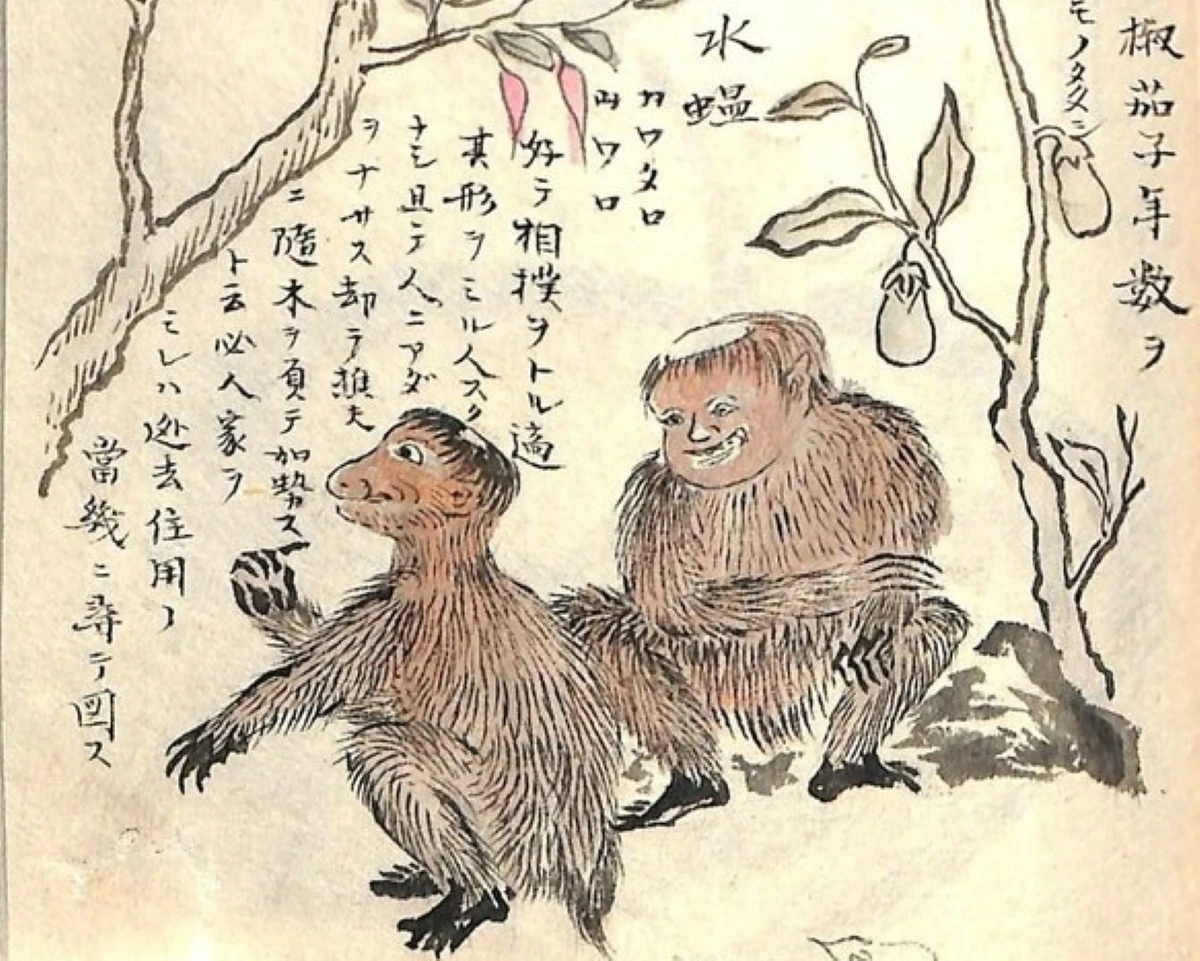

Kenmun (ケンムン), or Kenmon (ケンモン) are hairy humanoids that are believed to appear on the islands of Kagoshima Prefecture, Japan, especially on Amami Ōshima. It is believed to be related to the Kappa of Honshu, Shikoku, and Kyushu because of the depression on its head called sara and its preference for waterside areas. They could also be related to the Kijimunā of Okinawa as well because of their red hair, preference for fish eyes, living in banyan trees, and their hatred of octopuses.
Habitat
Kenmuns are native to the Amami Islands, also known by its native name as Amami-guntō, a Japanese archipelago in the Satsunan Islands, which is part of the Ryukyu Islands, and is southwest of Kyushu. Administratively, the group belongs to Kagoshima Prefecture, Japan. Kenmuns live in Japanese banyan trees, also known as Gajumaru in Japan and its scientific name, Ficus microcarpa.
Description
The Kenmun is like a cross between a Kappa and a Kijimunā, they're about the size of a child, sometimes slightly larger, their arms and legs are disproportionately long, so long that when it sits with its knees raised, its knees are higher than its head. Their bodies are covered in hair, the color of their hairs can vary from dark red to black, their faces are similar to that of a monkey, sometimes a dog, or a cat. They have sharp red eyes and pointed mouths, when they drool, their saliva glows an eerie blue light with a terrible smell. Like Kappa, they have saucer-like depressions on top of their heads called a sara, which can hold a small amount of water or oil. The odor of their bodies is similar to that of yamaimo, Japanese mountain yams.
Diet
Kenmuns primarily feed on fish and shellfish, though they particularly favor fish eyes (like the Kijimunā). Fishermen going to catch fish sometimes found they caught an unusually large amount, only to discover every fish had its eyes removed. Kenmuns do enjoy fishing, and appear at the seashore at night, lighting up the oil in their sara with their fingers to fish among the rocks. Humans who go fishing at night sometimes encounter them. Kenmuns also eat snails and slugs. For snails, they remove the shell and roll the flesh into a ball like mochi. Large piles of snail shells and other shells are said to accumulate at the base of trees where Kenmun dwell.
Abilities
Kenmuns are shapeshifters, they have the ability to change their shape at will and transform into any living being they see, they often disguise themselves as humans, horses or cows. They can also transform into plants and blend into the surrounding vegetation, they can also disappear entirely. Kenmuns have the ability to generate fire from the tip of their fingers, they use it to light the oil in their head-dishes. When mysterious lights are seen in the mountains or on the shores of the Amami islands, it is called "Kenmun Machi".
Behavior
Being native to the Amami Islands, Kenmuns speak various dialects of the Amami language, also known as Shimayumuta, an indigenous language that is part of the Ryukyuan language family. By nature, Kenmuns are pretty gentle and do not harm humans. There are tales of Kenmuns helping woodcutters carry firewood, and of fishermen rescuing Kenmun being bullied by octopuses, for which they received a treasure in return, a magical object that produced rice without needing to be filled with rice grains. On Kakeromajima, it was common for elders to summon Kenmuns by voice and show them to children. However, like Kappa, some Kenmuns are pranksters that enjoy causing mischief, they will transform into animals to frighten people or pretend to offer directions only to lead them astray. They can also be thieves, stealing food and even utensils from humans without any shame. Stories were often heard of evacuees sheltering under banyan trees during wartime air raids having their meals eaten by Kenmun. The Kenmun would vanish afterward, leaving only the sound of clattering dishes behind. Throwing stones is also a form of mischief. There is a tale of a man rowing a boat at sea who, upon spotting what seemed like a child's figure on the distant shore, suddenly had enormous stones hurled one after another near his vessel. In the mountains, they can also make sounds like large rocks tumbling or trees crashing down.
Their fondness for sumo wrestling is a trait they share with Kappa and Kijimunā. Like Kappa, they lose their strength if the water or oil in the dish on their sara dries up. If challenged to a sumo match, performing a handstand or bowing will cause the Kenmun to imitate the action, spilling the contents of the dish on their head and forcing them to retreat. Kenmuns are very sensitive about being insulted, particularly about their body odors. Because of this, if a person talks about bad smells or farting while in the mountains, any Kenmun who overhear it will become upset.
Not all Kenmuns are docile and helpful. Some Kenmuns, especially in Kakeromajima and Tokunoshima, can be very dangerous and will cause harm to humans, they will abduct children and extract their souls. Children whose souls have been taken will then reanimate and start to behave like Kenmun, dwelling in banyan trees and darting between branches to escape when villagers approach. In such cases, it is said that placing a straw hat woven like a pot lid over the child's head and striking it with a stick will restore them. Adults too can be rendered unconscious, forced to eat snails, or dragged into rivers. Kenmuns are known to be territorial when it comes to protecting their home from any incursions caused by a human, if a woodcutter cuts the banyan tree where they live, the Kenmun will put a curse on that woodcutter. Those who are cursed by the Kenmun will suffer eye problems, the swelling will cause the person to go blind, and eventually, the cursed person dies.
Weakness
Similar to the Kijimunā, Kenmuns hate octopuses and giant clams. To drive away a Kenmun, all it takes for a person is to threaten it with an octopus. Merely threatening to throw an octopus at them is enough to send them running. If an octopus is not available to throw at them, they will also run away from a giant clam, or anything else a person throws at them as long as they pretend it’s an octopus. Some families of the Amami Islands hang pig foot bones or Japanese pittosporum branches from the eaves of their roofs in order to keep Kenmuns from coming close.
Sightings
On Tokunoshima Island, there were sightings of this species until the 1960s. However, few records of this time are known.
According to Director Nakayama of the Amami Museum, there were cases of Kenmun footprints being found around 1990, and some people claimed to have captured a Kenmun around 2000.
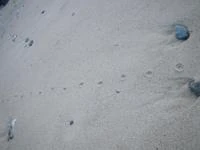

Kenmun footprints
On January 20, 2010, a person walking on the beach in Naze City on Amami Oshima Island found strange footprints. The footprints were circular, about 5 cm in diameter, and three toes were visible. The stride length was 20 cm, and the footprints existed for 20 meters.